
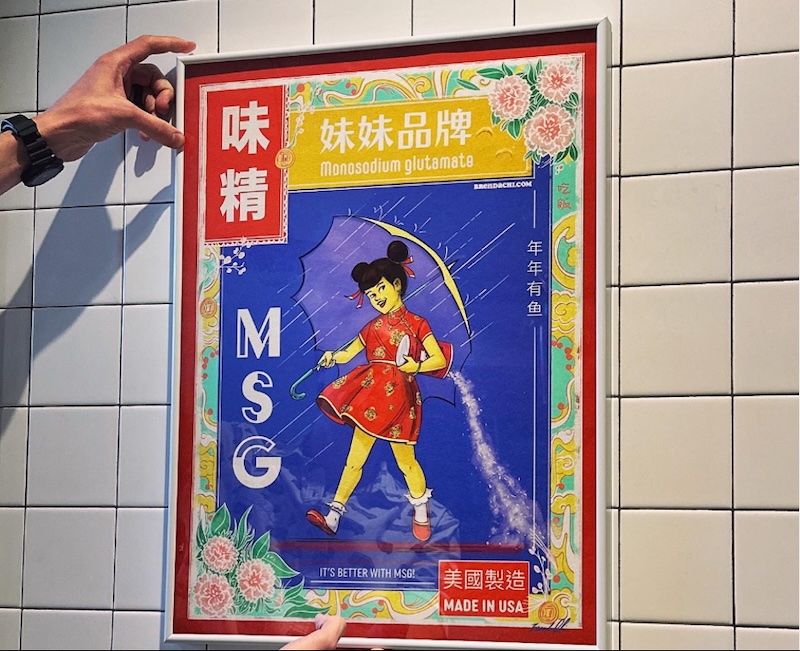
A smiling Asian girl in a traditional Chinese dress clutches a carton of MSG while a trail of white crystals spills behind her. The image, a playful riff on the iconic Morton Salt Girl, hangs prominently on the wall of MAKfam, the Michelin-recognized Denver restaurant owned by Doris Yuen and her husband, Chef Kenneth Wan.
For some diners, the poster sparks curiosity. For others, discomfort. And that reaction is exactly the point.
Today, Doris Yuen is one of Denver’s most visible advocates for monosodium glutamate, better known as MSG. At MAKfam, she and Wan openly celebrate the ingredient with an MSG-inspired cocktail called the MSGin, special dinners highlighting umami, and artwork that challenges decades of misinformation. But Doris’s journey to becoming an outspoken defender of MSG began with a very different belief.
“I grew up thinking MSG was bad for you,” she says. “My own mother taught me that. I never questioned it.”
Like many Asian Americans, she absorbed the same warnings that circulated widely throughout American culture. Her parents avoided MSG at home and cautioned her about eating too much Chinese restaurant food.
“They would say, ‘Don’t go out to eat so much because there’s a lot of MSG in food, and if you eat too much MSG, it’s not good for you.’”
As Doris spoke, I found myself internally agreeing. Her story felt uncomfortably familiar. Many of us who grew up in Chinese American households absorbed the notion that MSG was somehow dangerous. We accepted it because our parents accepted it, and our parents accepted it because that was the message they heard from the culture around them. For many Chinese immigrants, acceptance in America often meant blending in rather than standing out. They learned to be quiet about many things, including the food they ate and the traditions they brought with them.
In her early life, Doris, like many Chinese Americans—and like me—accepted the message about MSG as fact. Everything changed when Doris began having conversations with her husband Chef Kenneth Wan.
“Ken set me straight,” she says with a laugh.
Wan pointed out something Doris had never considered: MSG wasn’t unique to Chinese food. It could be found naturally in tomatoes, mushrooms, Parmesan cheese, broths, and countless foods consumed every day. Even pizza contains ingredients rich in glutamate, the compound responsible for umami, the savory fifth taste first identified by Japanese scientist Kikunae Ikeda in 1908.
The realization led her to a bigger question.
“If everyone else has MSG in their food, why are Chinese restaurants the ones being targeted?”
The answer, she came to believe, had less to do with science and more to do with history and xenophobia.
Doris saw that reality firsthand when she and Wan operated Meta Asian Kitchen at Denver’s Avanti Food & Beverage marketplace. People regularly approached their stall with a familiar question.
“Do you use MSG?”
When she answered honestly and said yes, many customers simply walked away. It was stories like this that led many Chinese restaurants to put up signs that said “No MSG” on their windows and menus.
 Listening to Doris, I found myself thinking about my brother’s Chinese restaurant on Long Island. When MSG became a controversy, he watched customers disappear. Eventually, he hung a “No MSG” sign in the window. The sign wasn’t there because the science had changed. It was there because the economics had. Families depended on that business, and Chinese restaurant owners learned quickly that challenging the narrative came with a cost. For decades, many Chinese restaurants felt pressure to distance themselves from MSG out of fear that customers would leave, complain, or even threaten legal action. In a way, Chinese restaurant owners learned to apologize for something that required no apology.
Doris recalls that even members of her own family worried about publicly embracing the ingredient: “My mother-in-law was worried someone would get sick and sue us.”
What frustrated her was that neighboring food stalls often served foods containing natural or added glutamates as well. Yet no one questioned them.
“People don’t know,” she says. “They just come up to the Chinese stall and ask if we use MSG. The more people kept asking me, the angrier I got, thinking this is so unfair. We were being singled out as a Chinese restaurant while other stalls also had natural or added MSG.”
Today, Doris does not hesitate to call that double standard what she believes it is.
“I think it’s just innately built into people’s minds that Chinese food with MSG is bad. I don’t think people associate that with racism. But it is racist.”
She poses a simple question.
“If you walk into a Chinese restaurant and ask if we use MSG, and we say yes and you walk out, why are you only targeting Chinese restaurants? Would you walk into a pizzeria and ask if they use MSG, even though MSG is found in Parmesan cheese and naturally in tomatoes and mushrooms?”
As a dietitian, I appreciated the irony when Doris pointed out that pizza, Parmesan cheese, tomatoes, mushrooms, ranch dressing, chips, and countless processed foods all contain glutamates. Yet no one walks into other restaurants and asks whether the chef uses MSG.
The Avanti Food & Beverage marketplace experience transformed her perspective. What began as confusion and questions evolved into anger, and eventually into very intentional advocacy.
What struck me most was not Doris’s anger, but her transformation: from unquestioning acceptance, to disbelief, to frustration, and ultimately to advocacy. It mirrors a journey many second-generation Asian Americans are making, reexamining long-held assumptions about food and culture, and perhaps, a measure of unacknowledged shame that accompanied them.
Today, Doris loudly and proudly answers yes when customers ask whether MAKfam uses MSG.
There is no hesitation. No apology. No shame. In the end, Doris isn’t really fighting for MSG. She’s fighting for the freedom to serve her family’s food, tell her family’s story, and have her children grow up proud of both.
At MAKfam, the restaurant’s embrace of MSG is impossible to miss. The MSG Girl poster hangs prominently on the wall. The cocktail menu features the MSGin. Conversations about umami and MSG are welcomed rather than avoided.
“We’re very upfront,” she says. “We’re proud to be pro-MSG.”
MAKfam still receives questions. Customers occasionally walk away after hearing that MSG is used in some dishes. Online critics continue to voice concerns. But Doris no longer sees those interactions as reasons to stay quiet.
Instead, she sees them as opportunities to educate.
“We want people to know that there’s no harm in eating MSG.”
 The issue is bigger than a seasoning. For Doris, reclaiming MSG is about reclaiming a narrative that unfairly targeted Chinese food and Chinese restaurants for generations. It is about challenging assumptions that many people have never stopped to examine. For Doris, the fight over MSG has never really been about a food additive. It is about replacing fear with facts, shame with pride, and silence with a voice strong enough for the next generation to hear.
Perhaps that is what makes Doris’s advocacy so meaningful. She is giving voice to questions that an earlier generation of Chinese restaurant owners rarely had the freedom to ask. When survival depends on keeping customers happy, challenging misconceptions felt risky and even impossible.
And it also is about creating a different future for her own family. One of the things that matters most to her is that her children grow up seeing their culture celebrated rather than questioned. She wants MAKfam to be a place filled with joy, pride, and belonging…a place where her children can walk through the door and feel proud of who they are.
As I left our conversation, I realized that Doris’s campaign is about much more than MSG. It is about giving the next generation permission to embrace their culture without apology. My parents’ generation often felt compelled to blend in. My brother’s generation hung “No MSG” signs to keep their businesses alive. Doris’s generation is asking a different question: What if we stopped apologizing? Perhaps that is the real story behind the MSG Girl poster hanging on the wall at MAKfam…not just a defense of an ingredient, but a declaration of pride.
You can watch Doris Yuen’s TEDxCU Talk, “MSG Is Umami,” on YouTube.
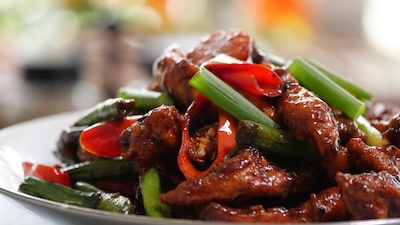
Chinese Restaurant Food Photo by Deepak Surya on Unsplash
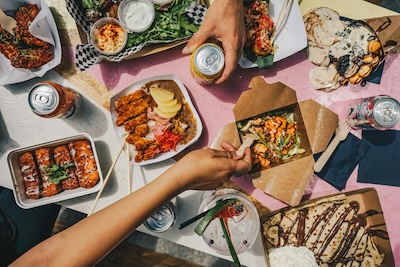
Food on Table Photo by Ambitious Studio* | Rick Barrett on Unsplash


Really enjoyed reading this! It’s a thoughtful reminder of how myths can shape opinions for generations. Thanks for sharing the history and helping people see MSG and Chinese food from a new perspective. ❤️✨