
How would you rate an ingredient that’s made up of only two components? Say the ingredient has a salt component (sodium) and an amino acid. The amino acid is one that your body makes itself. Let’s also say this ingredient amplifies the taste of foods, as does regular salt, but does so with about 60% less sodium.
This ingredient is MSG. And it’s been perplexing people who either choose to ignore sound scientific facts, or who have been believing the “junk science” perpetuated by those who choose to ignore sound science.
Let’s deal with the most common myths that have been perpetuated about MSG:
“MSG causes headaches & ‘Chinese restaurant syndrome.’”
This concept was germinated not by a study, but by a letter to the editor of a medical journal back in 1969. The writer said he’d experienced palpitations and headaches after eating in a Chinese restaurant, and suggested several possible reasons. MSG in the food was the only one that took hold, and it went viral. This generated a lot of subsequent research but no results tying MSG to symptoms, not even in double-blind, placebo-controlled trials – and not for the past 75 years.
Chefs, meanwhile, have caught on to the concept of “umami” – the power of certain foods and food components to amp up the flavor of foods. The “umami” is provided by glutamate, the same amino acid in MSG.
Funny, but chefs can give glutamate the thumbs-up, and people believe it more easily than evidence from 50 years of sound research that confirms the safety of MSG.
“Using regular salt is safer than MSG.”
Wrong. Both are equally safe, and appear on the Food and Drug Administration’s (FDA) list of ingredients that are “Generally Regarded as Safe” (GRAS). This list includes common ingredients such as baking powder, baking soda, and vinegar. Pretty benign. Ingredients can only make it onto this list if there is solid scientific evidence or if they have a long history of safe use. Vinegar, for instance, has been around for thousands of years.
Plus, numerous global health organizations have found MSG to be safe.
“Regular salt is still better for you than MSG.”
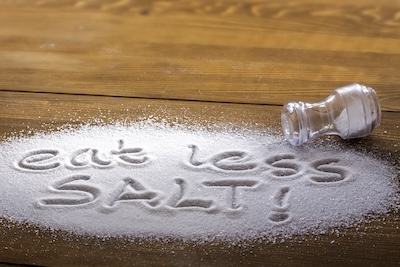 MSG is actually LOWER in sodium than regular salt. Gram-for-gram, MSG has 62% LESS sodium than regular salt. That means the more you use it in foods instead of regular salt, the more you can lower the sodium content of food.
You don’t need to stop using regular salt, because that would impact the taste of foods, but when you’re making savory foods, like soups, stews, and salad dressings, using a “house mix” of salt and MSG in a 1:1 ratio can enhance the flavor of foods and still reduce the added sodium by about 30%. Don’t you love a “win-win”?!
“Avoid MSG if you have hypertension.”
First, always follow your physician’s or health professional’s advice. There is a great deal of individual variation in sodium sensitivity. Ask your health professional what’s best for you.
That said, watching your sodium intake may not mean giving up all salt and MSG. Remember, MSG has 62% LESS sodium than regular salt.
Let’s look at the DASH diet (Dietary Approaches to Stop Hypertension) as an example. It focuses on including more fruits, vegetables, and low-fat dairy foods daily, because they help reduce blood pressure. Most people aren’t getting enough of these food groups as it is, so the DASH diet just helps them meet dietary recommendations, which is also one reason the diet was endorsed by the U.S. Government in its 2020-2025 US Dietary Guidelines for Americans as an example of a “healthy eating plan.”
But you have to eat these foods to get the benefits! And that means making them taste good to you, which is where adding just a smidgen of MSG can really enhance their flavor. If you like the flavor, you’re more likely to eat them, and do so daily. Read more about how MSG can be useful in a reduced-sodium diet.
“Pregnant women should avoid MSG.”
The FDA, the World Health Organization (WHO), and the Joint FAO/WHO Expert Committee on Food Additives (JECFA) have found MSG safe, including during pregnancy.
MSG is safe for the fetus, as it does not cross the placental barrier.
“Kids shouldn’t be given foods with MSG.”
 This myth really bothers me. I’ve worked with children and families for my entire career. There’s no way I’d ever recommend food with unsafe ingredients. MSG is safe. The FDA says so, as do the previously mentioned groups and numerous other global health organizations, noted in this summary.
“MSG is artificial.”
MSG is made by fermenting plant ingredients such as beets, corn, and cane sugar. It’s not unlike the fermentation process for yogurt. With yogurt, the fermentation produces lactic acid, which gives yogurt its slightly sour taste. MSG fermentation produces glutamic acid, which is the “glutamate” portion of MSG, and it’s what gives MSG the “umami” that chefs love.
Glutamate and sodium are natural!
No myth here! The only two components of MSG, sodium and glutamate, are naturally found in foods we love. Here are but a few:
- Tomatoes
- Mushrooms
- Parmesan and cheddar cheese, as well as most other cheeses
- Chicken
- Walnuts
- Broccoli
- Potatoes
The chemical structure of the sodium and glutamate found in food are exactly the same as the components in MSG.
See? You’ve been eating glutamate your entire life and probably didn’t know it! It was safe when you ate it as a child, and it’s safe for you and your family now. Just from the above list, you can see how many Italian and Asian dishes contain naturally found glutamate!
MSG Takeaway
I see MSG as a culinary and flavoring tool. By enhancing the flavor of foods, especially those we need to eat more of, it can help us accomplish our dietary goals and meet recommendations for a high-quality eating style. If used to reduce our use of regular salt, MSG can even help us reduce our overall sodium intake.
Those are the facts, not myths.

