

Food is personal. What we eat — and at times, perceive to be healthy — often stems from our personal experiences or beliefs, not facts.
In today’s environment, consumer insights reflect such reality. The recent Curious Plot Consumer Curious Report highlights that food is used to manage one’s emotions, health and budget simultaneously while the kitchen “is no longer where meals are made, but rather a sanctuary where people feel like themselves again.” It’s a place where we have control and seek to find the answers to “what’s in our food” and the “story” behind it.
However, in our quest to seek those answers, we often let myths or misinformation guide our decisions rather than evidence-based science. Such is the case of a century-old ingredient known as monosodium glutamate, or commonly known as MSG.
The Story of MSG
In one of my Rooted & Restless podcasts this year, Mary Lee Chin, MS, RDN and I discussed how cultural influence, taste preference and science came together to create MSG. In 1908, a Japanese professor, Dr. Kikunae Ikeda, loved his wife’s Japanese dashi, a broth made from seaweed, and sought to find out what was giving the broth a deep and savory flavor. So, as a curious scientist, using his research knowledge, he discovered it was glutamic acid. It was at this time Ikeda coined the term “umami” to describe the flavor.
A year later, Ikeda formed the Ajinomoto company with others to produce MSG, making the glutamate-based ingredient publicly available. Despite the common use of MSG in Asian culture, it wasn’t until 1985 that umami was recognized as a scientific term. Finally, around 2000, umami was identified as an official fifth flavor — a long journey for the rich and savory flavor that balances out the longtime-recognized sweet, sour, bitter and salty tastes.
Is MSG Natural?
When it comes to meeting consumer demands for natural ingredients, monosodium glutamate checks all the boxes. Originally extracted from seaweed, it’s now made through the fermentation of naturally occurring sugar and starches from plants like corn, sugarcane, or cassava. The fermentation process to make MSG is the same process that has been used to make beer, vinegar and yogurt for centuries.
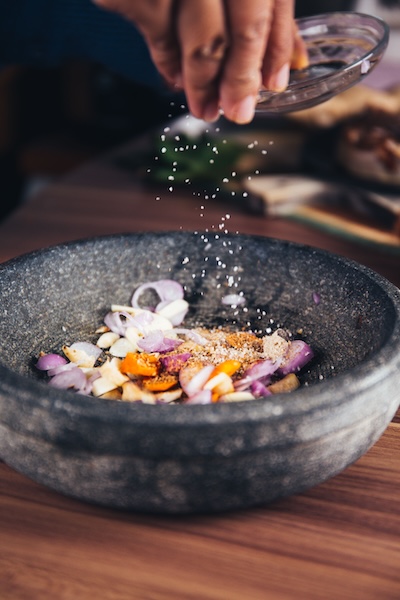
 Creating Savory Kitchen Comfort
If the kitchen is our sanctuary, creating an environment of enjoyment is the goal. Savory smells of simmering sauces along with the richness of every bite (without sacrificing health) can be achieved with just a small addition.
While MSG may be perceived as a high sodium ingredient, it’s quite the opposite. Compare the difference: 1/2 teaspoon of table salt contains approximately 1,200 mg of sodium, while a 1/2 teaspoon of MSG consists of 250–320 mg of sodium — approximately 60% to 70% less sodium.
Most recipes list ½ teaspoon or less of MSG when used as an ingredient, providing more flavor without the sodium.
When searching for MSG used as an ingredient in The New York Times Cooking recipes online, twelve were found. The amount of MSG was ¼ to ½ teaspoon along with other umami ingredients like soy sauce and often kosher salt, validating that it only takes a small addition of MSG to optimize the taste of umami.
MSG Acceptance: Food Culture Meets Science
MSG is often associated with Asian cuisines because glutamate was first identified in seaweed. Yet glutamate occurs naturally in many foods across cultures, especially protein-rich and fermented ingredients that are widely accepted and enjoyed.
Foods Naturally Rich in Glutamate
- Aged cheeses, such as Parmesan and cheddar
- Cured meats
- Mushrooms
- Soy sauce
- Tomatoes
These foods help create the savory, rich flavor we recognize as umami. It is ironic that a naturally occurring amino acid in familiar foods can be viewed differently when it is extracted and used as a seasoning.
Questions about MSG’s safety and potential health risks have been studied for decades, confirming the safety of the product. The broader takeaway is that decisions about MSG should be guided by evidence-based science rather than assumptions, myths, or its association with a specific culture.
Resources:
- The Consumer Curiosity Report. https://curiousplot.agency/curiosity-report
- Questions and Answers About Monosodium Glutamate. https://www.fda.gov/food/food-additives-petitions/questions-and-answers-monosodium-glutamate-msg
- MSG: A Brief History https://ific.org/resources/articles/msg-a-brief-history/
- Is It OK to Eat MSG? https://health.clevelandclinic.org/is-msg-really-harmful
- Monosodium Glutamate: What It Is and Why You May Consider Avoiding It, https://www.health.harvard.edu/diet-and-nutrition/monosodium-glutamate-msg-what-it-is-and-why-you-might-consider-avoiding-foods-that-contain-it
- Everything You Need to Know About Glutamate and Monosodium Glutamate, https://ific.org/resources/articles/everything-you-need-to-know-about-glutamate-and-monosodium-glutamate/
Seasoning Vegetables Photo by Dapur Melodi from Pexels

